
THE GALLERY
Where Scripture becomes visual story.
OUR HOLIDAY COLLECTION
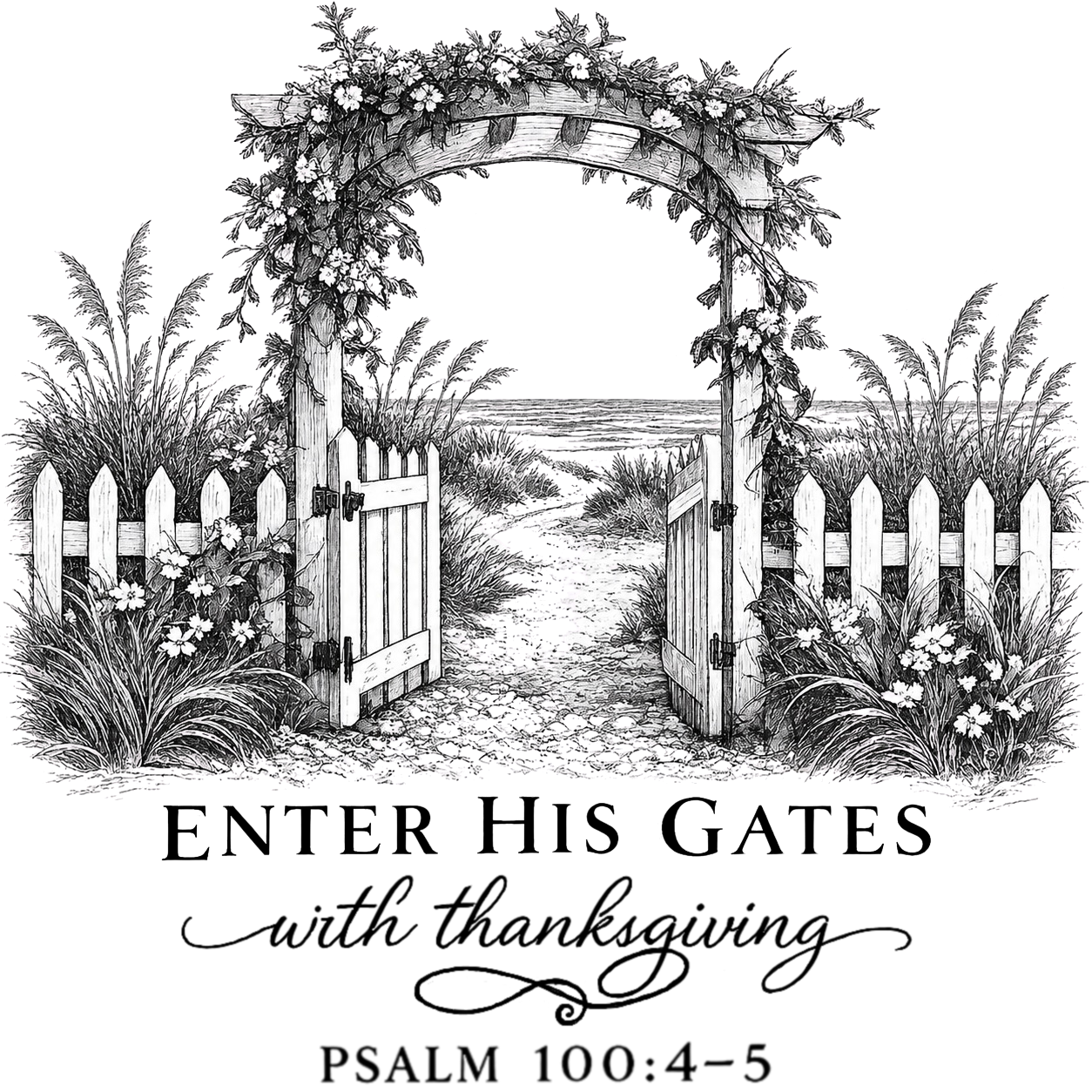
An open gate has always carried the feeling of invitation—an entrance into somewhere we are welcomed to come. For this design, I was drawn to the imagery of an open coastal garden gate leading toward the water, surrounded by sea oats and flowering vines. It felt like a beautiful visual expression of the words of Psalm 100:4: “Enter into His gates with thanksgiving, and into His courts with praise.” Rather than showing a closed or distant entrance, the gates are standing open, creating the sense that there is a way before us and an invitation to draw near.
When David writes, “Enter into His gates,” the “His” is the Lord God. In the worship of ancient Israel, the gates and courts were associated with approaching the place of worship and coming before God. But Psalm 100 is doing more than describing someone walking through a physical entrance. The entire Psalm is a call to recognize who God is: “Know that the LORD, He is God; it is He who has made us, and not we ourselves; we are His people and the sheep of His pasture.” The gates, then, represent an approach toward the presence of the One to whom we belong—our Creator, our Shepherd, and our God.
And Scripture tells us something important about how we are to enter: with thanksgiving. Thanksgiving is not merely the subject of the Psalm; it is the posture of the person approaching God. Before asking for something more, we remember what He has already done. Before concentrating on what may be missing, we acknowledge what has already been given. We enter recognizing His provision, His mercy, His faithfulness, and ultimately Him as the Giver. Thanksgiving turns our attention away from the gift alone and toward the One from whom every good thing comes.
Verse 5 gives us the reason such gratitude is always appropriate: “For the LORD is good; His mercy is everlasting, and His truth endures to all generations.” Our thanksgiving is therefore not dependent upon everything in our circumstances being perfect. We give thanks because God is good. His character has not changed. His mercy has not expired. His faithfulness has not reached its end. Generation after generation may pass through changing seasons, yet the God on the other side of those gates remains the same.
That is why the open gates in this design carry such meaning. They are an invitation not simply to celebrate a season called Thanksgiving, but to live as people who enter the presence of God with grateful hearts—remembering who He is, recognizing what He has done, and praising Him for the goodness and mercy that endure forever.
This design is a reminder that thanksgiving is more than something we bring to the table; it is something we bring into the presence of God.

There are seasons when thanksgiving comes easily, and seasons when it becomes an act of remembering. Psalm 107 does not tell us to give thanks because every season is easy, but because the Lord Himself is good—and His mercy never reaches an end.
The imagery for this design began with an old tree in autumn—one that looks as though it has stood through more seasons than anyone could count. Its trunk bears the evidence of years gone by, while leaves loosen from its branches and drift toward the ground. Beside them hangs an empty swing, quiet beneath a tree that has weathered much and still stands.
There is something fitting about that picture alongside the words of Psalm 107:1: “Oh, give thanks to the LORD, for He is good! For His mercy endures forever.” The command to give thanks is followed immediately by the reason for it. Scripture does not say, “Give thanks because everything around you is good.” It says to give thanks because He is good.
That distinction matters. Circumstances change. Seasons turn. Things we once held closely may eventually have to be released. There are years of abundance and years of difficulty, moments filled with laughter and others marked by loss. If our thanksgiving rests only upon what a particular season has brought us, gratitude can become as changeable as the season itself.
But the goodness of God is not seasonal.
Like the strength beneath the changing canopy of an old tree, His character remains. The leaves may come and go, but the tree is still rooted. In the same way, Scripture repeatedly calls us back from what is changing around us to the One who does not change. His goodness has not expired. His faithfulness has not reached its end. And according to this Psalm, His mercy endures forever.
The empty swing adds another layer to the story. A swing can hold memories of laughter, childhood, family, or simply a quiet place beneath the shade. Empty, it can suggest something that has passed; yet it also remains a place to return to. Beneath the branches of something steadfast, there is still room to sit, to remember, to rest, and even to find joy again.
Perhaps that is part of what thanksgiving asks of us. Not to pretend that nothing has changed, and not to call every circumstance good, but to remember the goodness of God in the midst of what has changed. Gratitude turns our attention from the season itself to the One who has remained faithful through every season.
Psalm 107 begins with thanksgiving and then tells the stories of people who experienced distress, wandering, bondage, affliction, and storms—and again and again, the Lord delivered them when they cried to Him. The Psalm’s opening declaration therefore is not shallow optimism. “He is good” is the testimony of people who have discovered that His mercy can be trusted even through difficult places.
The old tree, the falling leaves, and the waiting swing become a picture of that kind of remembrance. Years pass. Leaves fall. Seasons change. But what is deeply rooted remains.
Our thanksgiving is rooted not only in what God has given, but in who God has always been. Circumstances change. Seasons pass. But His goodness remains—and His mercy endures forever.

There is a remarkable story behind the quail and bread in this design. After God delivered the Israelites from slavery in Egypt, He led them into the wilderness—a place where the food they needed could not simply be grown, gathered, or supplied in the ordinary ways they had known. Yet the wilderness that revealed their need also became the place where God revealed His provision.
When His people hungered, God provided quail for them to eat and manna from heaven. Exodus describes the manna appearing with the morning dew, something unfamiliar to the Israelites and gathered according to God’s instruction. Psalm 105 later looks back upon that provision and describes it beautifully: “The people asked, and He brought quail, and satisfied them with the bread of heaven.”
That is why both the quail and the bread appear in this design. They are not simply symbols of a meal. Together they point backward to a wilderness where ordinary resources were insufficient, but God was not.
Psalm 105 begins by telling God’s people what to do with memories like these: “Oh, give thanks to the LORD! Call upon His name; make known His deeds among the peoples!” The Psalm then recounts what God had done throughout Israel’s history. In other words, their thanksgiving was connected to their remembering. They were to look back at the evidence of God’s faithfulness, give Him thanks, and then tell others what He had done.
That makes verse 1 and verse 40 especially meaningful together. Verse 1 gives the response—give thanks and make His deeds known—while verse 40 gives one of the many reasons why. The God to whom they were giving thanks was the God who had heard the needs of His people and provided for them where provision seemed impossible.
There is also something important about the way God provided. Manna was not a storehouse Israel carried into the wilderness. It was provision they received day by day. They gathered what God supplied according to His instruction, learning in a very tangible way that their continued sustenance depended upon Him. The wilderness stripped away many of the ordinary sources upon which people might naturally depend and made the Provider unmistakable.
And yet Scripture also shows us that receiving provision and remembering the Provider are not always the same thing. A gift can be enjoyed while the Giver is gradually forgotten. That is one reason the repeated biblical call to remember matters so much. God did not merely want Israel to remember that bread once appeared; He wanted them to remember the One who had sustained them.
That truth reaches naturally into thanksgiving. A table filled with food can make abundance easy to see. But biblical thanksgiving asks us to look beyond what is sitting before us and recognize the One from whom provision comes. The gift points beyond itself to the Giver.
And provision does not always look like abundance. Sometimes it looks like enough for today. Sometimes it is strength we did not think we had, a way opening where we could not see one, help arriving at the needed moment, or sustaining grace through a season we would never have chosen. The wilderness account reminds us that God’s provision can become especially visible in places where our own resources have reached their limits.
There is an even greater biblical significance to the words “bread of heaven.” Generations after Israel gathered manna in the wilderness, Jesus spoke of that history and directed His hearers beyond the manna itself. In John 6, He declared, “I am the bread of life.” The manna had sustained physical life for a time, but Christ pointed to Himself as the One who gives life in its fullest and eternal sense.
So the bread in this design carries a story that reaches farther than a single wilderness meal. It reminds us of a God who sees need, hears His people, provides what they cannot provide for themselves, and ultimately gives far more than provision from His hand—He gives us Christ.
The quail and bread therefore invite us to do exactly what Psalm 105 calls God’s people to do: look back, remember, give thanks, and make His deeds known. We remember the places where He sustained us, carried us, opened a way, or supplied what we could not have supplied for ourselves. And in remembering, our attention moves from what was provided to the One who provided it.
This design is a reminder to remember the Provider, not merely the provision. When our resources are insufficient, God is not. Give thanks for what He has provided—but above all, remember the faithful God from whom every provision comes.

There is something beautiful about fragrance: although it cannot be seen, its presence can become unmistakable. A fragrance escapes its vessel, spreads into the surrounding air, and can linger long after the person carrying it has passed by. That imagery is what drew me to the perfume bottle in this design. Its open bottle and flowing fragrance visually represent something Scripture says should happen through the lives of those who belong to Christ—His presence and His truth should extend beyond us, reaching the people and places around us.
In 2 Corinthians 2:14, Paul writes, “Now thanks be to God who always leads us in triumph in Christ, and through us diffuses the fragrance of His knowledge in every place.”
Those opening words make this an especially meaningful design for the Thanksgiving season:
Thanks be to God.
But the thanksgiving Paul expresses here is not merely for a pleasant circumstance or a visible blessing. It is thanksgiving rooted in Christ’s triumph and in the extraordinary privilege of being used by God to make Him known.
Paul’s imagery would have carried special meaning in his day. A Roman triumphal procession celebrated victory, and incense was often burned along the route, filling the air with fragrance. Paul takes that familiar picture of triumph and turns our attention to a far greater victory: Christ’s. God leads His people in Christ, and as we follow Him, He uses our lives to spread the knowledge of Jesus wherever we go.
That alone is a beautiful thought. But Paul takes the picture even further in the very next verse: “For we are to God the fragrance of Christ” (2 Corinthians 2:15).
What a remarkable description of the Christian life.
We are not called merely to wear the name of Christ outwardly or to speak of Him only in formal moments. As He changes us, something of Christ Himself should become evident through us—through the truth we speak, the grace we extend, the love we show, the humility we practice, the peace we carry, and the way we respond even in difficulty.
Like fragrance drifting from an open vessel, a life surrendered to Christ can quietly carry evidence of Him wherever God places us.
And importantly, the fragrance is not ours. It is Christ’s.
That matters deeply.
This design is not about drawing attention to ourselves or trying to appear especially good, polished, or spiritual. The perfume bottle is not the source of what matters most; what matters is what flows from it. In the same way, the beauty of a Christian life is found in reflecting the One who fills it.
When others encounter His mercy, truth, patience, faithfulness, or love through us, they may be catching the fragrance of something far greater than us—the transforming presence of Christ.
There is also a quiet humility in the image of fragrance. Fragrance does not force itself upon people with noise or spectacle. It reaches them almost invisibly, yet undeniably. That seems fitting for so much of how Christ works through His people. A word spoken in season, a kindness offered sincerely, a steady faith in hardship, a spirit of gentleness, a heart of gratitude, or a life marked by quiet obedience can leave behind more of Christ than we may ever realize.
We may never fully know who notices, who is encouraged, who is drawn toward the Lord, or whose heart is stirred by what they witnessed in us. But Scripture reminds us that God is able to use lives yielded to Christ in ways that extend far beyond what we can measure.
That makes this a beautiful Thanksgiving design in another sense as well. Thanksgiving is not only about acknowledging what God has given to us; it is also about recognizing what God is doing through us. Paul’s words turn gratitude outward. We thank God not only for leading us in Christ, but for allowing our lives to become vessels through which His knowledge is carried into the world.
So the open bottle in this design becomes more than a decorative image. It becomes a reminder of calling.
If we belong to Christ, then our lives are not meant to remain closed in upon themselves. God desires that His truth, grace, and presence would diffuse outward through the way we live.
That is the heart behind this design. The sweeping fragrance rising from the open bottle is a reminder that wherever God places us, our lives have the opportunity to leave behind the knowledge of Jesus. And what an extraordinary purpose it is to walk so closely with Christ that something of Him lingers wherever we have been.
This design is a reminder to give thanks to God for the triumph of Christ—and to live in such nearness to Him that His knowledge diffuses through us in every place. May our lives, as Paul so beautifully wrote, become “the fragrance of Christ.”

There is something both beautiful and challenging about the first two words of this verse: “In everything.”
Paul does not tell believers to give thanks only when prayers are answered as hoped, circumstances are comfortable, or life feels abundant. He writes, “In everything give thanks; for this is the will of God in Christ Jesus for you.”
The wording matters. Paul says in everything, not for everything. Scripture does not ask us to call every circumstance good, nor does biblical gratitude require us to pretend that pain, grief, disappointment, injustice, or loss are somehow blessings in themselves. Rather, believers are called to give thanks in the midst of every circumstance because even when circumstances change, the character of God does not.
Paul wrote these words to believers who understood hardship. The Thessalonian church had received the gospel “in much affliction, with joy of the Holy Spirit,” and Paul commended their faith and endurance. So this was not shallow advice to simply look on the bright side. These words were written to people who already knew that following Christ did not make them immune to difficulty.
Their thanksgiving could therefore rest upon something deeper than favorable circumstances.
There is a beautiful context surrounding 1 Thessalonians 5:18 as well. Paul writes, “Rejoice always, pray without ceasing, in everything give thanks.” These are not isolated ideas. Together they describe a life continually turned toward God—rejoicing in Him, remaining in communion with Him, and responding to Him with gratitude.
That means thanksgiving becomes more than a reaction to receiving something we wanted. It becomes an expression of trust in Who God is, even when we cannot yet understand what He is doing.
Paul then gives an extraordinary reason: “for this is the will of God in Christ Jesus for you.”
We sometimes think of God’s will primarily in terms of questions we want answered: What decision should I make? Where should I go? What will happen next? Yet here Scripture reveals something God has already clearly told His people He desires—a life oriented toward Him with gratitude.
We may not always know God’s purpose in a particular circumstance. We may not know why something was permitted, how a story will end, or what tomorrow will bring. But we do know that in Christ there remain realities no changing circumstance can erase: His salvation, His presence, His promises, His mercy, and His faithfulness.
That is what makes thanksgiving possible even when thanksgiving is difficult.
During the Thanksgiving season, those words carry particular weight. Some tables will be overflowing. Families will gather. Prayers will have been answered. There will be laughter, familiar traditions, and countless visible reasons to thank God.
But not every Thanksgiving looks that way.
There can also be an empty chair. A prayer still unanswered. A relationship that has changed. Financial uncertainty. Illness. Grief. A waiting season. Or circumstances no one would ever have chosen.
“In everything give thanks” does not require those realities to disappear before gratitude can begin.
Sometimes thanksgiving is joyful praise for what God has given. At other times, it may be a quiet declaration made through tears: I still know Who You are.
That kind of gratitude is not denial. It is faith.
It acknowledges what hurts while refusing to allow what hurts to become the final word about the goodness of God. It remembers that the same God who was faithful yesterday remains faithful today, and that circumstances do not possess the authority to redefine His character.
Perhaps that is why thanksgiving is more than a holiday sentiment. A holiday comes once a year. Biblical thanksgiving is meant to become a posture of the heart.
It can accompany abundance and need, celebration and sorrow, answers and waiting. It can be spoken loudly around a crowded table or whispered quietly when no one else hears.
Because ultimately our gratitude is not anchored to the certainty that everything happening to us is good.
It is anchored to the certainty that God is still good in everything.
This design was created as a reminder that thanksgiving is not merely a holiday sentiment—it is a posture of faith. In every blessing, every waiting season, every answered prayer, and even through the places we do not yet understand, we can turn our hearts toward God and give thanks—not because everything that happens is good, but because He is still good in everything.
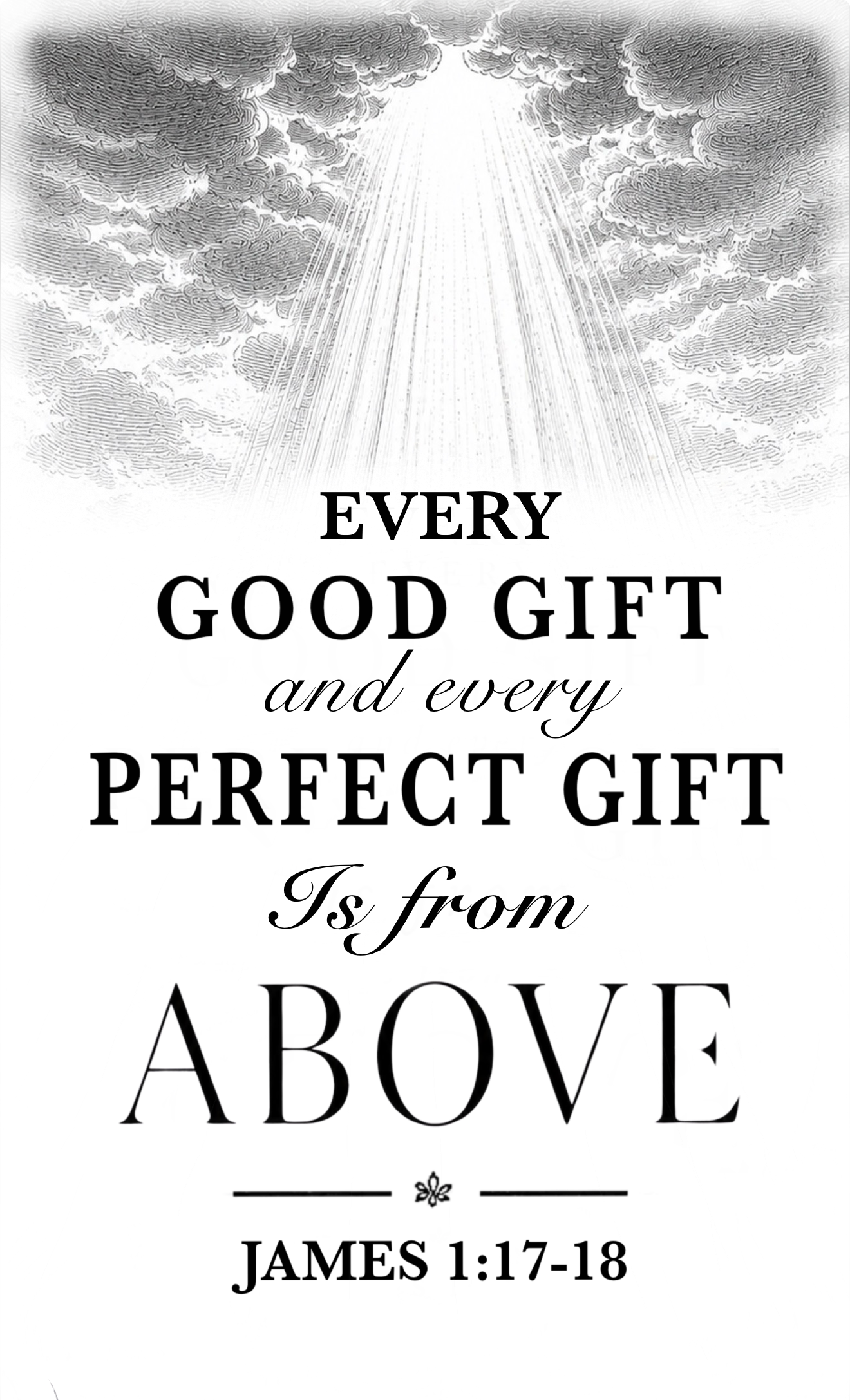
The opening in the clouds was chosen to give visual form to the words James uses so beautifully: “from above.”
Light pours downward through a break in the darkness—not because every circumstance beneath it is easy or pleasant, but because its source is higher than the circumstances themselves. The surrounding clouds make that distinction especially meaningful. There can be darkness around us, uncertainty before us, and trials pressing against us—and still, what comes from God remains good.
That truth carries even greater weight when these verses are read in their context. James begins his letter speaking to believers about trials, telling them that the testing of their faith produces perseverance. Only a few verses later, he addresses temptation and makes an important distinction: God is not the source of evil, nor does He tempt anyone with evil.
Then James turns our eyes upward.
“Every good gift and every perfect gift is from above, and comes down from the Father of lights.”
Those words tell us something not merely about the gifts, but about the Giver.
When difficulty makes us question what is happening around us, James reminds us to remember Who God is. Darkness may enter our circumstances, but darkness does not originate in Him. What is truly good finds its source in a God who is Himself good.
James then gives God a remarkable name: “the Father of lights, with whom there is no variation or shadow of turning.”
The imagery is beautiful. The lights God created in the heavens appear to us to move and change. Shadows shift. Day becomes night and night becomes day. Seasons turn. Yet the Creator of those lights is not changeable like the shadows they cast.
His goodness does not brighten and dim according to our circumstances.
His character does not shift when our lives do.
The God who was good when His provision was obvious remains good when we cannot yet see what He is doing. The God we thanked in abundance remains worthy of our trust in uncertainty. The clouds may change; the Source of the light does not.
That is why the rays in this design do not originate below. They break through from above. Visually, they draw the eye beyond what surrounds us toward the One from whom every truly good thing comes.
And James does not leave the idea of God’s giving only in the realm of material blessings. Verse 18 takes us deeper: “Of His own will He brought us forth by the word of truth.”
The Giver has done more than place good things into our hands. He gives life.
For the believer, that makes salvation one of the clearest and greatest evidences of the goodness of God. When circumstances make His goodness difficult to see, we can look back to what He has already done and know something about the heart from which His gifts come.
And here, standing at the threshold of the Christmas story, the language of gift, light, from above, and life begins to prepare our hearts for what comes next.
Christmas celebrates a moment when God’s goodness was not merely spoken about from heaven. In the fullness of His redemptive plan, He sent His Son into the world.
That does not mean James 1:17 is specifically a Christmas verse. Its truth is much broader than one season. But during Christmas, its words give us a beautiful posture with which to receive the season: rather than allowing our attention to stop at the gifts themselves, we allow every good gift to turn our eyes back toward the Giver.
The presents beneath a tree will eventually be opened. Decorations will come down. Another season will pass. But the Father from whom every good and perfect gift comes does not change.
No variation. No shadow of turning.
And perhaps that is the deepest meaning of the opening in these clouds. The design does not ask us to deny the clouds. It asks us to look beyond them.
This design is a reminder to look above what we can presently see. The clouds may gather, but they cannot change the character of the One beyond them. In seasons of abundance, His gifts are good. In seasons of testing, He is still good. And every truly good and perfect gift ultimately leads our eyes back to its Source—the loving, unchanging Father above.

At first glance, the spelling Immanuel may look unfamiliar to those accustomed to seeing Emmanuel, especially at Christmas. Both are correct English forms of the same name and carry the same meaning. Immanuel reflects the form commonly used in translations of Isaiah’s prophecy: “Behold, the virgin shall conceive and bear a Son, and shall call His name Immanuel” (Isaiah 7:14), while Emmanuel reflects a form rendered through Greek.
This design intentionally uses Immanuel, allowing the wording of Isaiah’s ancient prophecy to carry forward into the moment Matthew declares its fulfillment: “They shall call His name Immanuel,” which is translated, “God with us.”
Those final three words contain the wonder of Christmas.
God with us.
Matthew is recounting the moment Joseph learns that Mary’s Child was not the result of ordinary human circumstances. What had been conceived in her was of the Holy Spirit, and the Son she would bear would “save His people from their sins.” Matthew then reaches backward centuries to Isaiah’s prophecy and tells us that what God had promised was now taking place.
The long-awaited sign had become a living reality.
God had come to be with us.
There is something especially beautiful about the movement from Isaiah to Matthew. Isaiah spoke into one historical moment, yet Matthew, under inspiration, identifies the birth of Jesus as the fulfillment toward which those prophetic words ultimately pointed. What had once been promise was now present. What had been spoken beforehand had entered history.
And “God with us” means far more than God being near in a general or comforting sense.
In Jesus Christ, God entered the human story. John describes the wonder another way: “the Word became flesh and dwelt among us.” The One through whom all things were made took on flesh and lived among the people He came to redeem.
He entered a world acquainted with weakness, sorrow, temptation, suffering, and death—yet He Himself was without sin. He did not remain at a distance from the human condition. He came into it.
That is what makes the Christmas story so astonishing. The infinite entered the finite. The Creator entered His creation. The promised Son was born into the world He had come to save.
And He came with a purpose.
Matthew tells us before giving the name Immanuel: “You shall call His name JESUS, for He will save His people from their sins.” The two declarations belong beautifully together.
Jesus — He will save His people from their sins.
Immanuel — God with us.
Christmas therefore cannot be separated from redemption. The Child in Bethlehem came to become the Savior who would bear sin at the cross and open the way for sinners to be reconciled to God.
The distance sin had created between humanity and a holy God would ultimately be answered by the very Son whose birth Matthew announces.
And that gives the words God with us a depth far beyond the manger.
Christ would walk among us. He would teach, heal, grieve, suffer, die, rise again, and promise His people His continuing presence. Near the end of Matthew’s Gospel, the One introduced as Immanuel gives His disciples another remarkable assurance: “I am with you always, even to the end of the age.”
Matthew begins with God with us and closes with Christ promising, I am with you always.
That makes Immanuel more than a beautiful Christmas title. It tells a story stretching from prophecy, to Bethlehem, to the cross and resurrection, and onward into the life of every believer who belongs to Christ.
And that is why this design needs no manger, star, angel, shepherd, or other familiar Christmas imagery.
The name itself tells the story.
IMMANUEL is the announcement.
GOD WITH US is its meaning.
And the delicate words above it—“And they shall call His name”—remind us that this was not a title invented after His birth. It was a name spoken in prophecy long before Bethlehem and recognized in its fulfillment when Christ came.
After looking upward in the previous design toward every good and perfect gift “from above,” the Christmas story now brings our attention to something extraordinary:
The Son did not remain above.
He came to us.
This design is a celebration of one of the most astonishing truths of the Christmas story: the God who seemed far away did not send salvation from a distance. He came Himself. The promised Son entered our world, dwelt among us, and made a way for us to belong to Him.
Immanuel—God with us then, God with us now, and through Christ, the promise that His people will never again have to live apart from His presence.

A sea star becomes an unexpected picture of the star that led the wise men to Jesus. Rather than depicting the familiar Christmas star in the sky, this design brings that image to the coast through the beautifully detailed Royal Sea Star, a species found along the coast of North Carolina and especially meaningful to the coastal roots of Sea Oat Roots.
Its natural beauty made it a fitting choice, but so did its name.
Royal.
That quiet detail gives the sea star a beautiful connection to the One whom the wise men were seeking—the Child born King.
The words “We have seen His star” come from Matthew 2:2: “For we have seen His star in the East and have come to worship Him.” Those men had seen a sign in the heavens, and rather than ignoring it, admiring it from afar, or stopping short with curiosity alone, they followed where it led.
That is what makes this moment so significant.
Their journey was never ultimately about the star.
The star was the sign.
Jesus was the destination.
Matthew tells us that after the wise men came to Jerusalem and later saw the star again, they rejoiced with exceedingly great joy. Then, when they entered the house and saw the young Child with Mary His mother, they fell down and worshiped Him.
What began with seeing became seeking.
What began with seeking became following.
And what began with following finally brought them to worship.
That progression gives this design its deeper purpose.
The Royal Sea Star is not meant to replace Bethlehem’s star, but to serve as a coastal reflection of what that star did: it pointed to Christ. Even the beauty of creation is most meaningful when it turns our attention toward its Creator. The wise men did not stop at the sign God gave them; they allowed it to lead them all the way to Jesus.
And once they reached Him, their response was not merely wonder.
It was worship.
There is something especially fitting about using a sea star in a design like this. Its five arms stretch outward from one center, and its detailed form naturally invites the eye to linger. In that way, it mirrors the way a sign captures attention. Yet its purpose is not to keep attention for itself, but to direct it elsewhere.
That is true not only of the star in Matthew’s Gospel, but of all faithful signs.
They are meant to lead beyond themselves.
At Christmas, it is easy to become captivated by beautiful things—the lights, the decorations, the songs, the traditions, the imagery, and the atmosphere of the season. Many of these things are lovely, and they can stir real wonder in us. But the danger is that we can admire the signs while missing the One to whom they are meant to point.
Matthew 2 quietly warns against that very thing.
The chief priests and scribes in Jerusalem could explain where the Christ would be born, yet it was the wise men who set out to find Him. Knowledge alone was not enough. Proximity alone was not enough. They responded to what they had seen by moving toward Christ.
That is what holy wonder is meant to do.
It should not end in sentiment, nostalgia, or admiration alone. It should lead us toward Jesus.
And when it leads us there, the proper response is still the same as theirs: worship.
The word Royal in the name of this sea star becomes especially meaningful here. The wise men were seeking the One born King of the Jews. Their gifts and their posture both recognized His worth. The sea star, with its quiet royal name, becomes a subtle coastal reminder that the Child they came seeking was no ordinary child.
He was the promised King.
And yet the marvel of Matthew’s account is that the One they came to worship was found not in worldly splendor, but in humility. The greatness of Christ was not diminished by the lowliness of His coming. If anything, it made the wise men’s worship all the more striking. They saw beyond appearances and responded to who He truly was.
That is part of the invitation of this design as well.
Not merely to admire the beauty of the season, but to let every beautiful thing become a signpost directing the heart toward Christ.
The sea star, then, becomes a reminder that God often uses signs to awaken pursuit—but the signs are never the end. They are invitations to move closer, to seek more fully, and to continue until we arrive where true worship belongs.
This design is a reminder to follow the wonder all the way to Jesus—to see the sign, seek the King, and when we find Him, worship.

Long before there was a manger in Bethlehem, there was a promise.
Hundreds of years before the birth of Jesus, the prophet Isaiah spoke of a Child who would come: “For unto us a Child is born, unto us a Son is given.” But this would be no ordinary child. Isaiah continued by giving Him names that revealed who He would be—Wonderful, Counselor, Mighty God, Everlasting Father, Prince of Peace.
The promised Messiah would enter the world as a child, yet He would carry an identity and a kingdom far greater than His humble arrival might suggest.
Then, generations later, beneath the night sky outside Bethlehem, promise became reality. An angel appeared to shepherds and announced, “For there is born to you this day in the city of David a Savior, who is Christ the Lord.”
What Isaiah had spoken centuries before was no longer only something Israel was waiting to see.
The Child had been born.
The Son had been given.
The Savior had come.
That is why Isaiah 9:6 and Luke 2:11 stand on opposite sides of the manger in this design. Isaiah looks forward toward the promised Child; Luke looks upon His arrival and tells us who He is. Between them lies the tiny hand of Jesus—the fulfillment of the promise.
The hand reaching upward from the swaddling cloth is deliberately small, vulnerable, and unmistakably that of a baby.
There is no crown upon His head.
There is no earthly throne beneath Him.
There is no royal palace surrounding Him.
There is only a newborn Child, wrapped in cloth and laid where animals were fed.
And yet He is the Prince of Peace.
That contrast is at the heart of this design.
The One Isaiah called Mighty God entered His creation in astonishing humility. The Savior did not arrive displaying the kind of earthly power mankind might have expected from a king. He came as an infant who could be held in His mother’s arms.
And yet His humility did nothing to diminish His identity.
He did not become King because the world recognized Him as one.
He was King even while lying in the manger.
Even the tiny hand becomes part of the story.
The hands that would one day touch the sick, bless children, break bread, reach toward the brokenhearted, and ultimately be pierced at the cross first entered this world as the hands of a newborn.
That makes the tenderness of the manger even more profound. The Child lying there had come with purpose.
Christmas was never merely about the birth of a baby.
It was about the arrival of a Savior.
And the title Prince of Peace carries far more meaning than the quiet tenderness we often associate with the Christmas season. Jesus did not come merely to create a peaceful atmosphere or to offer a temporary feeling of calm. He came to accomplish the peace humanity could never create for itself—the reconciliation of sinful people to a holy God.
Sin had created a separation human effort, goodness, achievement, or religion could never repair.
The Child in the manger came to do what we could not.
The cradle therefore points forward to the cross.
The Savior announced in Bethlehem would ultimately give Himself for sin so that through Him we could be forgiven, restored, and brought near to God.
That is what makes the peaceful little hand in this design so powerful.
The hand of the Child in the manger belongs to the Savior who came to rescue us.
Christmas is therefore not only a celebration of His arrival. It is a celebration of God keeping His promise to send the One we desperately needed.
And there is another beautiful truth hidden in the language of these two passages.
Isaiah says:
Unto us a Child is born.
Unto us a Son is given.
Then centuries later, the angel echoes that deeply personal language:
“There is born to you this day…a Savior.”
The promise was not merely that a Child would be born somewhere in history.
The gift was given for us.
That language turns the manger from something we merely admire into something that calls for a response. The Prince of Peace came so that those who turn to Him, repent, believe, and receive Him may know the peace of belonging to God.
And that peace is deeper than favorable circumstances.
The world may still be turbulent. Grief may still come. Questions may remain unanswered. Yet reconciliation with God gives a peace rooted not in everything around us being settled, but in the greatest separation of all having been answered through Christ.
That is why this design intentionally allows the manger to remain humble while the words Prince of Peace sweep beautifully and prominently beneath it.
The grandeur is not in the surroundings.
The grandeur is in the identity of the Child lying there.
The world may have seen a baby wrapped in swaddling cloth.
Isaiah saw the promised Son.
The shepherds heard that the Savior had arrived.
And heaven knew exactly who had entered the world.
This design is a reminder that Christmas began with a promise kept: the Child Isaiah foretold came exactly as God had said. The baby lying among the hay was the promised Son, the long-awaited Messiah, Christ the Lord, our Savior and Prince of Peace. The world may have seen only a newborn in a manger—but heaven knew exactly who had arrived.

Not long after Jesus was born, Mary and Joseph brought the infant Jesus to Jerusalem to present Him to the Lord. Luke records a quiet detail that can easily be passed over: they offered “a pair of turtledoves or two young pigeons.”
To understand why those two little birds matter, we have to go back to Leviticus.
Under the Law, after the birth of a child, a mother was ordinarily to bring a lamb for a burnt offering together with a young pigeon or turtledove for a sin offering. But God had also written merciful provision into the Law for those who were not able to bring a lamb. Leviticus 12:8 says that if she could not afford one, she could instead bring two turtledoves or two young pigeons.
That is the provision reflected in Luke’s account.
Mary and Joseph came faithfully with the offering the Law permitted for those of limited means. Their sacrifice was not lesser in obedience because it was smaller in cost. God Himself had made provision for exactly such circumstances.
And yet the contrast is breathtaking.
They came without a lamb for the sacrifice—while carrying in their arms the Lamb beyond price.
The turtledoves in this design represent the humble offering Luke records. But there is deliberately no lamb pictured beside them.
The missing Lamb is the heart of the story.
He was already there.
God had placed Him in Mary’s arms.
Years later, when John the Baptist saw Jesus approaching, he would declare:
“Behold! The Lamb of God who takes away the sin of the world!”
The infant Mary carried into the Temple would one day become the sacrifice no earthly offering could equal.
That does not mean Jesus was the Levitical offering Mary was substituting for that day; the two passages belong to different moments and purposes in Scripture. But viewed through the full story of Christ, the contrast becomes extraordinary: while Mary brought the sacrifice God’s Law permitted, she was also carrying the One whom Scripture would later reveal as the Lamb of God.
Peter uses similar language when describing the price of our redemption. Believers were not redeemed with corruptible things such as silver or gold, he writes, but “with the precious blood of Christ, as of a lamb without blemish and without spot.”
So the two small birds become a surprisingly powerful Christmas image.
They tell us something about the humility into which Jesus entered.
The One Isaiah called Mighty God did not enter an earthly family surrounded by wealth and royal privilege. The King did not arrive in circumstances the world would have recognized as kingly. His parents came to the Temple bringing the offering their means allowed.
And yet heaven had entrusted to them treasure beyond earthly calculation.
That is one of the recurring mysteries of the Christmas story: greatness concealed within humility.
A King in a manger.
A Savior carried in His mother’s arms.
The Lamb of God present beside an offering of two little birds.
What appears small by earthly standards can carry enormous significance in the purposes of God.
There is another tenderness hidden here as well.
God had written provision for limited means into His Law long before Mary and Joseph ever entered that Temple. Their offering was not an embarrassment before God. They did not arrive with something He had reluctantly agreed to accept.
They came exactly as His own Law had allowed them to come.
That reveals something beautiful about the character of God. His commands did not make obedience available only to those with abundance. He had made provision for those who could not bring what others could bring.
They came with the offering their circumstances allowed, while carrying the Offering heaven had provided.
And that turns our attention beyond the Temple.
Christmas is not merely the story of God placing a Child into the world. It is the beginning of the earthly life of the One who came to give Himself for the world.
The cradle points toward Calvary.
The Child carried into the Temple would grow into the Savior who willingly laid down His life. The One Mary held would become the One who bore sin. The Lamb beyond price would accomplish what no animal sacrifice could ever finally accomplish.
That is why this seemingly small detail in Luke matters so much.
Two birds could be easy to overlook.
But once we understand why they were there, they become part of a much larger story—a story of humility, mercy, obedience, sacrifice, and redemption.
From Bethlehem, to the Temple, and ultimately to Calvary, the Lamb had come.
This design is a reminder that Mary and Joseph came with the offering their means allowed, while carrying the One no earthly treasure could purchase. The lamb they could not bring that day points our attention to the Lamb God Himself had provided—the spotless Christ who would one day give Himself for the sins of the world.
They could not bring a lamb; yet God had entrusted to them the Lamb beyond price.
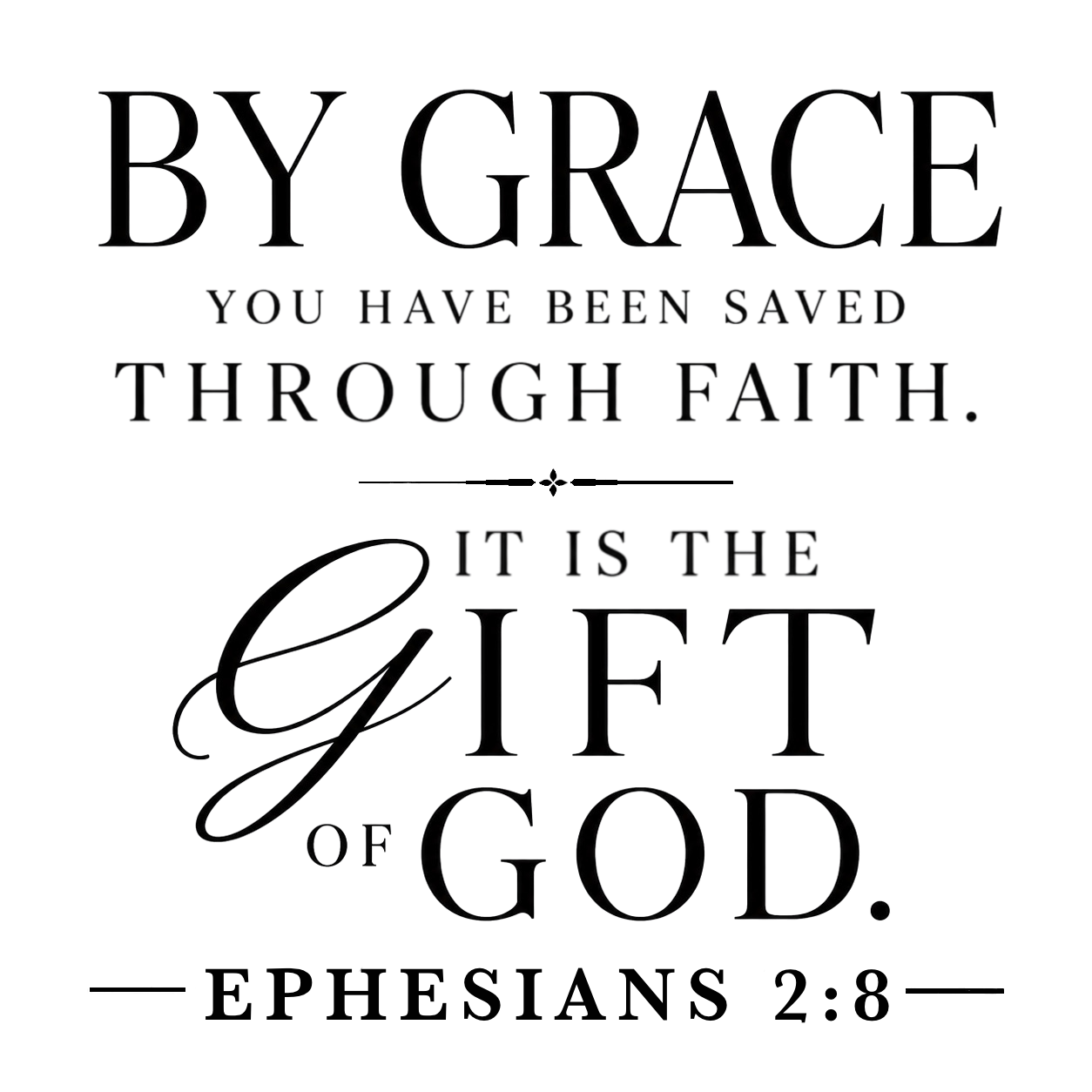
This design was chosen for one of the greatest gifts Scripture ever places before us—a gift that cannot be purchased, deserved, achieved, or earned.
Paul writes in Ephesians 2:8:
“For by grace you have been saved through faith … it is the gift of God.”
With no imagery surrounding the message, the typography allows the truth itself to become the entire focus:
BY GRACE.
THROUGH FAITH.
GIFT OF GOD.
There is nothing else competing for our attention because nothing else needs to.
But grace becomes even more remarkable when we understand the condition from which it saves us.
Earlier in Ephesians 2, Paul does not describe humanity as basically good people needing a little improvement. He says that apart from Christ we were “dead in trespasses and sins.” That is strong language. Sin is not merely an unfortunate habit or a collection of mistakes that can be corrected with enough effort. It has separated us from the holy God who made us.
Scripture says elsewhere that “all have sinned and fall short of the glory of God.”
No amount of comparison with someone else can change that. We do not stand before God measured against the person next to us. We stand before the perfection of His holiness—and every one of us falls short.
That is what makes the next words in Ephesians so beautiful:
“But God…”
Paul says that God, who is rich in mercy, because of His great love with which He loved us, made us alive together with Christ.
Grace begins not with what we accomplished for God, but with what God did for us.
He did not leave sinful humanity to somehow climb its way back to Him. He acted in mercy. Jesus Christ bore sin at the cross, died, and rose again, accomplishing what we could never accomplish for ourselves.
That is why salvation can only be received as grace.
Grace means favor we did not earn and could never demand.
It means that God does not wait until sinners make themselves worthy enough to approach Him. If worthiness were the requirement, none of us could come.
Instead, Christ Himself becomes our only hope.
Paul immediately guards this truth against human pride: salvation is “not of works, lest anyone should boast.”
We cannot purchase it with good deeds.
We cannot accumulate enough religious activity to earn it.
We cannot balance our wrongdoing with generosity, morality, church attendance, service, or personal improvement and then present the total to God as payment.
Salvation is not God rewarding the people who managed to become good enough.
It is God extending grace to sinners through Christ.
And that means there is no room for boasting.
If salvation were something we achieved, we could point to ourselves. We could say that our discipline, goodness, intelligence, morality, or religious devotion had secured our place with God.
Grace removes that possibility entirely.
The saved person points not inward and says, Look what I accomplished.
The saved person points to Christ and says, Look what He has done.
That is also why the words through faith matter.
Faith is not another kind of work by which we purchase salvation. It is the means by which we receive what Christ has accomplished. We place our trust not in what we can do for God, but in what Jesus has already done for us.
We come with empty hands.
And grace fills them.
Perhaps one of the most astonishing things about grace is that God knows completely the ones He is saving.
He is not extending mercy because He has overlooked the truth about us.
He knows every failure.
Every sin.
Every hidden place.
Every motive.
Every way we have fallen short.
And still He calls sinners to come to Christ.
Grace does not tell us that sin never mattered. The cross tells us just how seriously sin matters.
But the cross also tells us how far the love and mercy of God were willing to go to rescue sinners.
Christ paid the price Himself.
And once we understand that, even the word gift becomes more profound.
A gift may be free to the person receiving it, but that does not mean it cost nothing.
Our salvation comes to us freely by grace, but it was purchased at immeasurable cost to Christ.
The Lamb we encountered in the previous design—the One whom John called “the Lamb of God who takes away the sin of the world”—is the reason grace can be offered.
The Lamb gave Himself.
And sinners receive what they could never buy.
There is another important truth immediately following Paul’s declaration that salvation is not of works. Verse 10 says that believers are “created in Christ Jesus for good works.”
Good works therefore have a beautiful place in the Christian life—but they are in the proper order.
We do not do good works in order to be saved.
We are saved by grace, and then a life transformed by Christ begins to produce the good works God prepared for us.
Grace does not leave us unchanged.
It changes the reason we obey.
We no longer live hoping somehow to earn God’s acceptance. We live in response to a salvation already received through Christ.
That is why the simplicity of this design matters.
There is no illustration explaining grace because the words themselves carry the entire message.
BY GRACE tells us the source.
THROUGH FAITH tells us how it is received.
GIFT OF GOD tells us whose work salvation ultimately is.
And the absence of anything decorative competing with those words mirrors the gospel itself: nothing can be added to Christ’s finished work to make it more complete.
This design is a celebration of salvation as the gift it truly is—a reminder that we do not stand before God because we earned our place there, but because Jesus made a way for us to come. We bring Him no claim of our own goodness, only faith in His finished work. By grace we are saved. Through faith we receive it. And the glory belongs entirely to God.
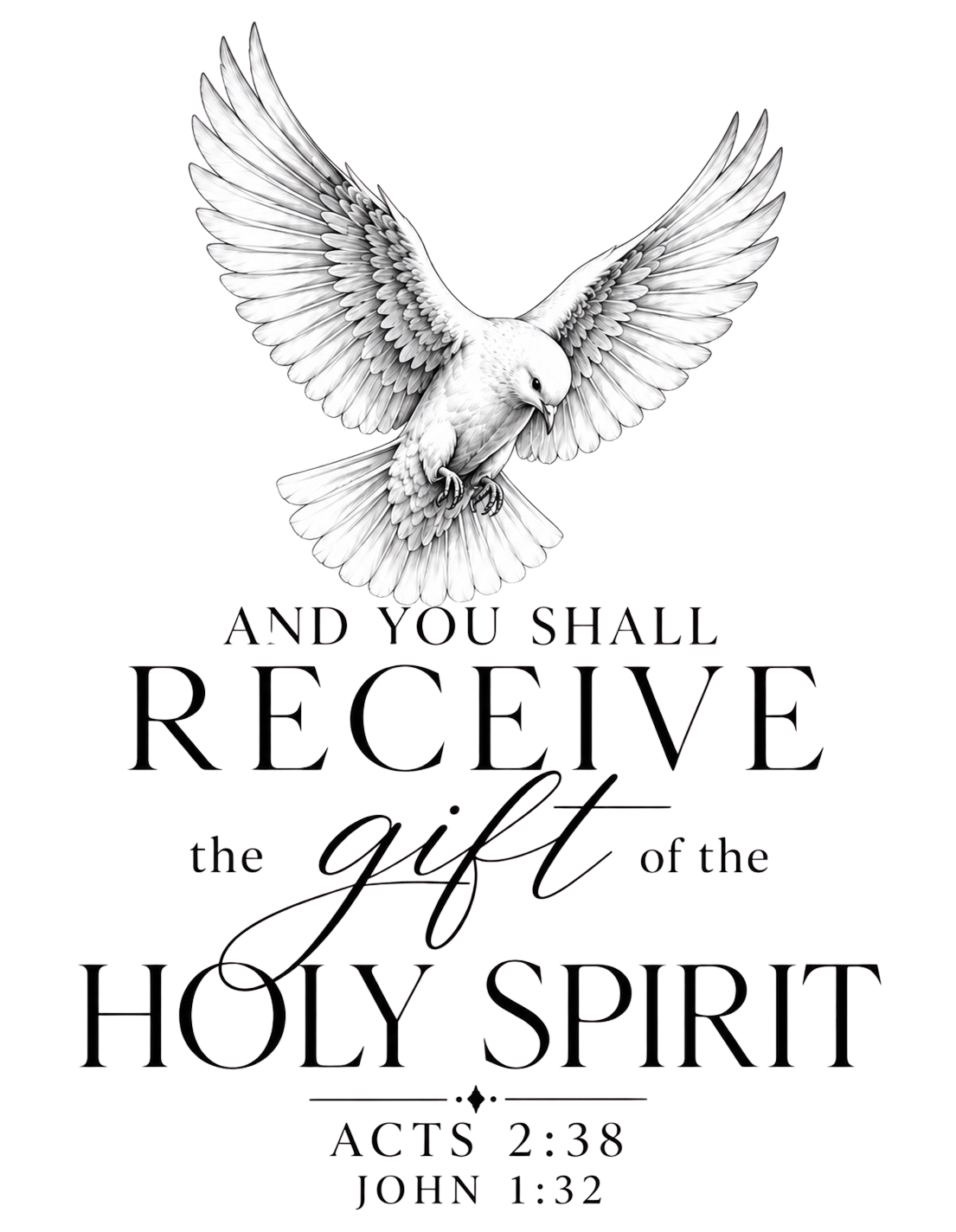
The dove in this design is shown descending—wings opened, head lowered, and feet extended as though preparing to arrive and remain.
That posture was intentional.
It was inspired by John’s testimony concerning Jesus: “I saw the Spirit descending from heaven like a dove, and He remained upon Him” (John 1:32).
John does not say that the Holy Spirit is a dove. Rather, he describes the Spirit descending like a dove. The image therefore gives us a visible way to reflect upon something that cannot otherwise be pictured: the Holy Spirit coming from heaven and remaining upon Christ.
That is why the dove in this design is not flying away or merely passing overhead.
It is coming down.
And beneath it are words from another extraordinary moment in Scripture.
In Acts 2, after Peter proclaimed the crucified and risen Jesus as both Lord and Christ, those who heard him were “cut to the heart” and asked, “What shall we do?”
Peter answered:
“Repent, and let every one of you be baptized in the name of Jesus Christ for the remission of sins; and you shall receive the gift of the Holy Spirit.”
Those words contain both a call and a promise.
There is the call to turn from sin and turn toward Jesus Christ.
And then there is this remarkable assurance:
You shall receive the gift of the Holy Spirit.
That word gift matters.
The Holy Spirit is not a reward earned by religious performance, human goodness, or spiritual achievement. Scripture speaks of Him as God’s gracious gift to those who belong to Christ.
And that makes this design a natural continuation of the one before it.
By Grace You Have Been Saved reminded us that salvation itself cannot be purchased or earned. It is the gift of God.
Now this design takes us one step further.
The God who saves does not then leave His people to live the Christian life alone.
He gives His Spirit.
The Holy Spirit is not merely an influence, an emotion, or an abstract spiritual force. He is the Spirit of God—the divine Presence at work in the lives of God’s people.
Jesus Himself spoke repeatedly of the Holy Spirit whom the Father would give. He promised His disciples that they would not be abandoned, and that the Spirit would teach, remind, guide, testify of Christ, and dwell with them.
So when Acts 2 speaks of receiving the gift of the Holy Spirit, it speaks of something far greater than receiving a temporary spiritual experience.
It speaks of God giving His people His own abiding Presence.
That truth gives special meaning to the word RECEIVE in this design.
Receive is different from achieve.
Different from earn.
Different from deserve.
A gift is received because someone else has chosen to give it.
That is the gospel pattern we have been tracing throughout this Gallery.
God sent the Son.
Christ gave Himself.
Salvation is given by grace.
And God gives His Holy Spirit to those who belong to Christ.
Again and again, the movement begins with the Giver.
That is also why the direction of the artwork matters.
The dove descends from above toward the prominent word RECEIVE, while the word gift flows beneath it. The imagery creates a movement between heaven and the one receiving.
What John witnessed at Christ’s baptism gives the image its direction:
the Spirit descending from heaven like a dove.
And Peter’s words at Pentecost give the design its invitation:
“You shall receive the gift of the Holy Spirit.”
The picture and the words together remind us that this Gift originates with God and comes from Him.
And there is another beautiful connection to the Christmas season.
Christmas is a season filled with giving and receiving. Gifts are wrapped, exchanged, opened, and enjoyed. Yet even the most meaningful earthly gift is temporary.
Scripture turns our attention toward gifts no box could ever contain.
The Father gave His Son.
Through Christ comes forgiveness, reconciliation, and eternal life.
And those who belong to Christ are not left alone; God gives the presence of His Holy Spirit.
That transforms the language of Christmas giving into something much deeper.
The greatest gifts are not the ones we place beneath a tree.
They are the gifts that came from God Himself.
And unlike temporary gifts, the Holy Spirit is not given merely to decorate our lives or make them more comfortable. His presence changes us.
He draws attention to Christ.
He convicts of sin.
He teaches truth.
He produces fruit in the life surrendered to Him.
He strengthens God’s people for obedience and gives power for witness.
His work continually turns us away from self and toward Jesus.
That means the descending dove in this design ultimately points beyond itself, just as the star did earlier in this collection.
The dove is not the destination.
Christ is.
The Holy Spirit glorifies Christ, makes His truth known, and works within His people so that the life of Jesus becomes increasingly evident through them.
That makes receiving the Spirit not merely a private blessing, but the beginning of a life meant to bear witness to the One who gave Him.
There is also something beautiful in John’s wording:
“He remained upon Him.”
The Spirit did not simply descend and disappear.
That language of remaining echoes the larger biblical truth that God does not merely visit His people and then abandon them. Through Christ, those who belong to Him are brought into a life marked by His continuing presence.
The Christmas name Immanuel—God with us therefore continues to unfold.
God came to us in Christ.
And through the Holy Spirit, God continues His work within His people.
This design was created to turn our thoughts from the temporary gifts we exchange with one another toward the eternal Gift God offers through Jesus Christ—the salvation we could never earn, the new life we could never give ourselves, and the beautiful promise that those who turn to Christ are not left alone, but are given the gift of His Holy Spirit.

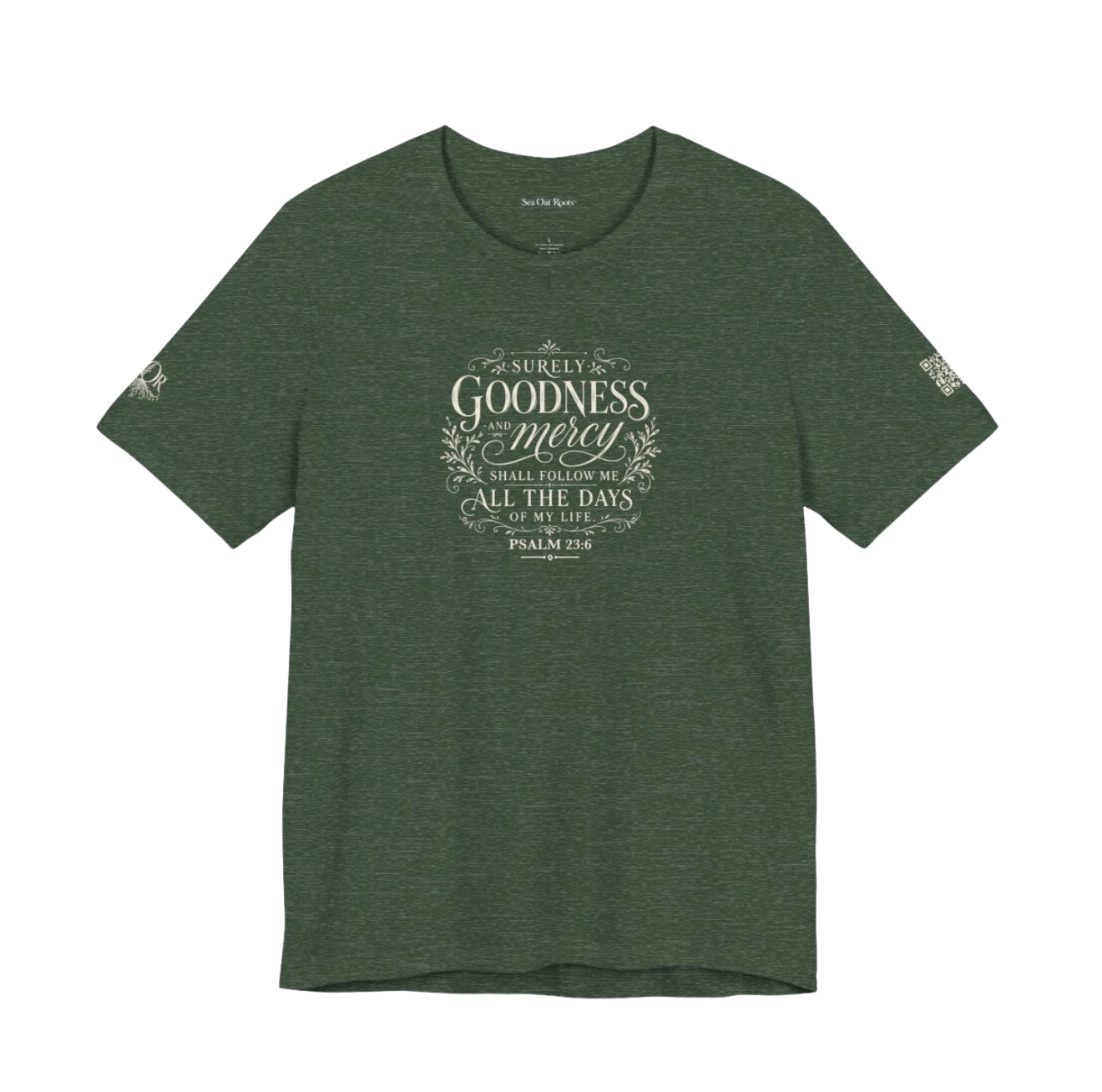
Few passages of Scripture have brought more comfort through the generations than Psalm 23.
David describes the Lord as a Shepherd who provides, leads, restores, guides, protects, comforts, and remains with His people—even through “the valley of the shadow of death.” By the time he reaches the final verse, David is no longer simply describing what the Shepherd does along the journey. He is expressing the deep confidence that comes from knowing Who the Shepherd is.
That is what drew me to the beautiful promise at the heart of this design:
“Surely goodness and mercy shall follow me all the days of my life.”
The word surely matters.
David does not say that he merely hopes God’s goodness and mercy might remain near him. He speaks with assurance. The Shepherd who has faithfully led him thus far will not suddenly abandon him on the road ahead.
That confidence is not rooted in an easy life.
Psalm 23 includes green pastures and still waters, but it also includes dark valleys, enemies, and the need for comfort in fearful places. The promise of verse 6 is not that every day will be free from sorrow or difficulty. It is that through every kind of day, the Shepherd Himself remains faithful.
That is why goodness and mercy are such precious words here.
God’s goodness reflects His loving character, His generosity, and His constant inclination to do what is right and kind toward His people.
His mercy speaks of steadfast love, compassion, covenant faithfulness, and grace we could never earn.
Together, these two words tell us that the believer’s journey is not marked merely by the circumstances visible to the eye, but by the faithful presence and character of God.
There is something especially beautiful in David’s choice of the word follow.
In English, “follow” can sound passive, as though goodness and mercy are simply trailing at a distance behind us. But the Hebrew sense is much stronger. It can carry the idea of pursuing, following after, even pressing closely behind.
What an extraordinary picture.
God’s goodness and mercy are not fragile blessings we must anxiously try to keep from slipping away.
They pursue His people.
Even when we walk through seasons we do not understand, God’s faithful care does not cease.
Sometimes we recognize His hand immediately.
Other times, only in looking back do we begin to see how He sustained us, guarded us, corrected us, provided for us, and carried us through places we once feared would undo us.
Yet even then, the testimony remains the same:
He was faithful there too.
This promise belongs within the larger relationship Psalm 23 describes.
David begins, “The LORD is my shepherd,” and he ends, “I will dwell in the house of the LORD forever.”
That means verse 6 is not detached from the rest of the psalm. The confidence that goodness and mercy will follow belongs to the life of one who knows the Shepherd, trusts Him, and follows where He leads.
We do not follow God in order to earn His goodness and mercy.
We follow because He is already good and merciful, and therefore we can entrust ourselves to His care.
That makes this design more than a comforting sentiment.
It is a call to confidence.
The graceful branches surrounding the words frame the verse like a treasured declaration, and at the center GOODNESS and mercy receive the greatest emphasis because they are the promise this design is meant to leave upon the heart.
Whatever road lies ahead, the child of God does not walk it alone.
The Shepherd goes before.
His rod and staff still comfort.
His presence still steadies.
And His goodness and mercy still follow.
This becomes especially meaningful after the designs just before it in the Gallery.
We have seen salvation presented as the gift of God.
We have been reminded that those who belong to Christ receive the gift of the Holy Spirit.
And now Psalm 23 assures the believer that the life ahead is not left to chance, nor navigated alone.
The God who saves also shepherds.
The God who gives His Spirit also continues His faithful care.
That means the Christian life is not only about a beginning moment of salvation, but about an ongoing journey under the watchful eye of the Shepherd.
There will still be valleys.
There will still be unknowns.
There will still be days when we need restoring, guidance, correction, comfort, and grace.
But there will never be a day when the Shepherd ceases to be who He is.
And because He remains unchanged, His people can move forward with a confidence deeper than circumstance.
Not confidence in themselves.
Confidence in Him.
This design is a reminder to stay close to the Shepherd, trust His leading, and move forward with confidence—not because we have been promised a life without valleys, but because we have been promised the presence of the One who walks through them with us. And when we look to the days still before us, we can say with David: surely—yes, surely—His goodness and mercy will follow.
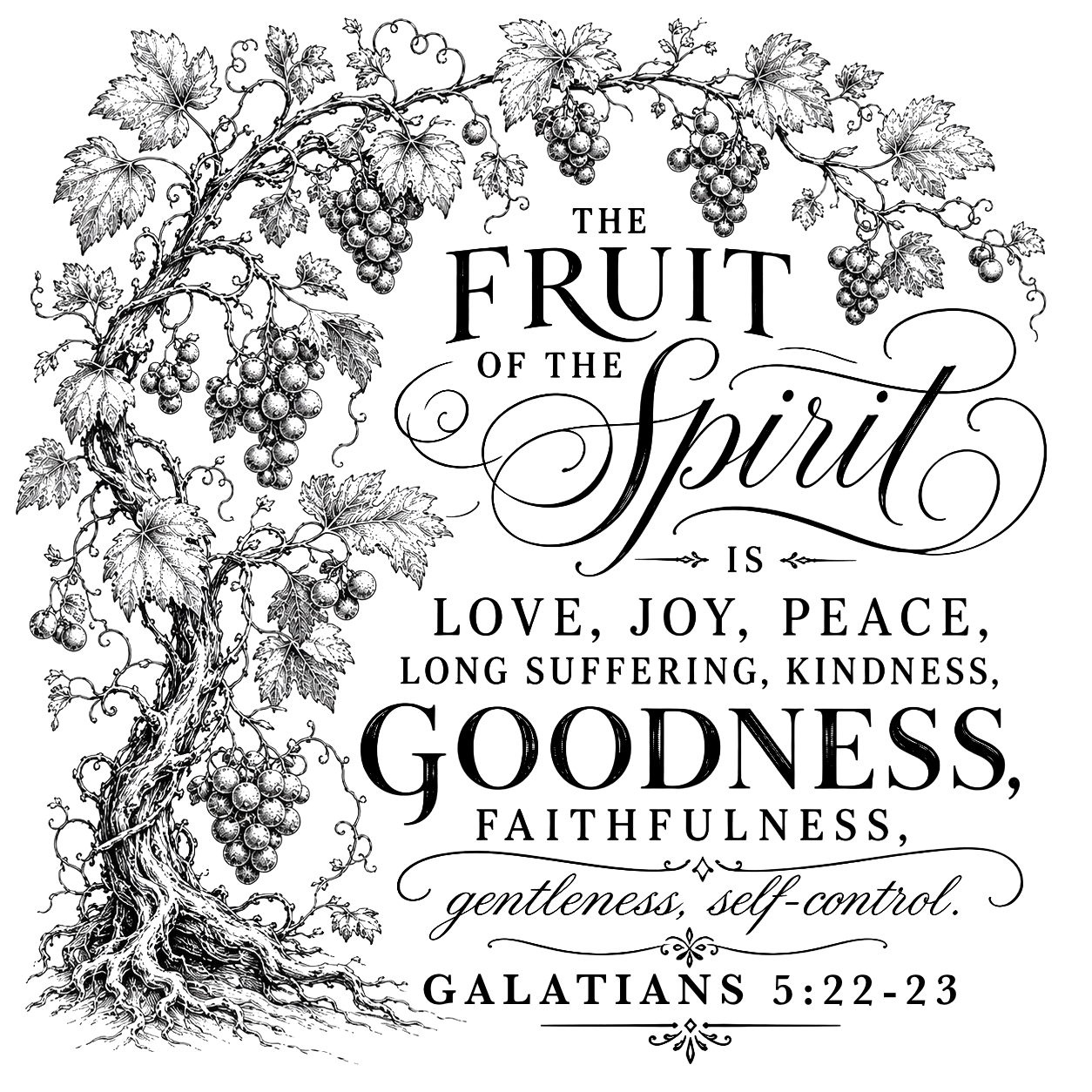
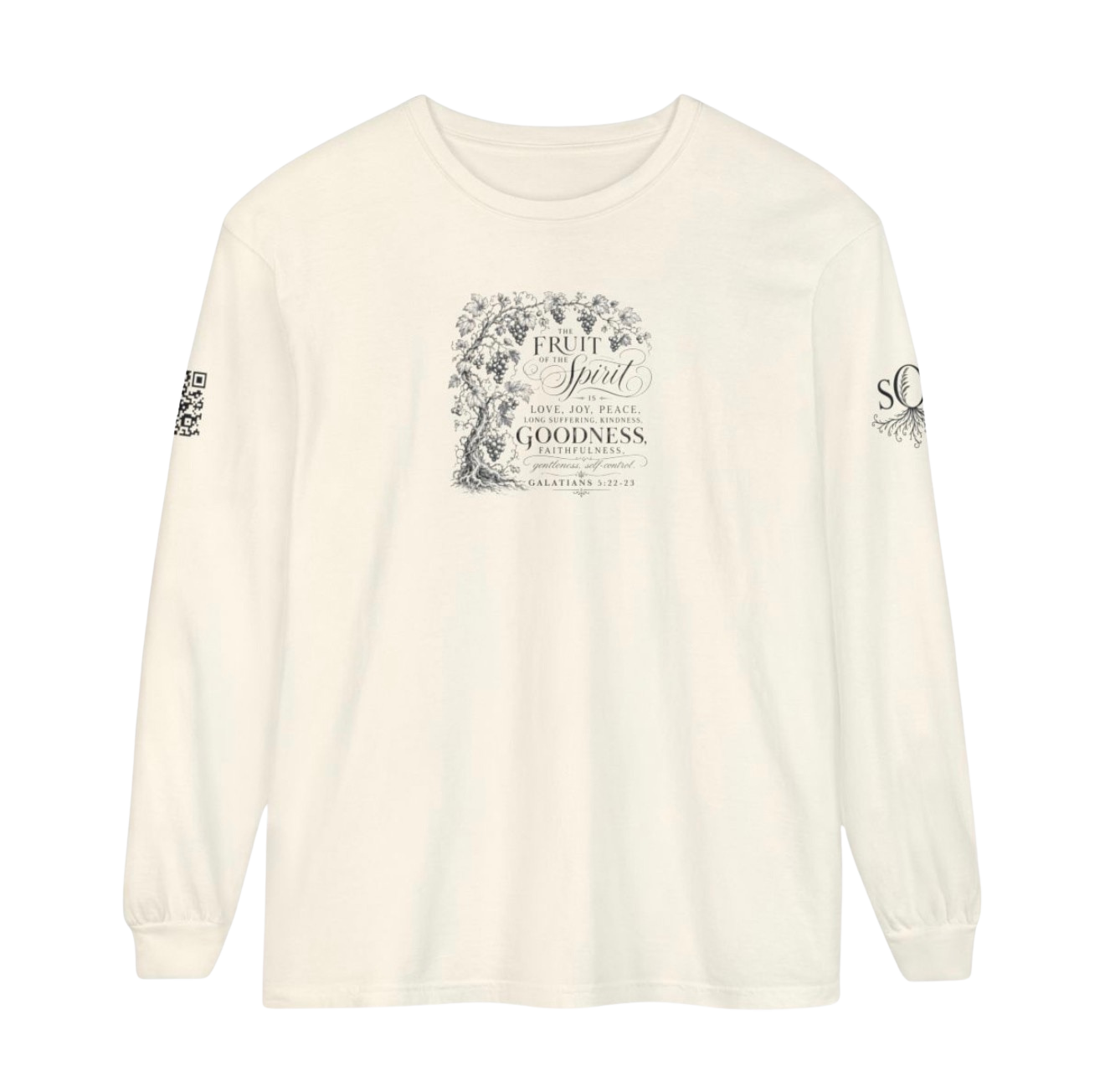
The grapevine in this design was chosen with intention. Rather than depicting an ordinary vineyard grape, it reflects the muscadine grapevine native to the southeastern United States and deeply rooted in North Carolina, where Sea Oat Roots was born.
Muscadines grow on vigorous, woody vines and produce clusters of richly colored fruit—a familiar sight in the coastal South. That local connection made the muscadine especially meaningful for illustrating Galatians 5:22–23: something firmly rooted, living and growing, eventually revealing through its fruit what has been taking place within the vine all along.
Paul writes:
“But the fruit of the Spirit is love, joy, peace, longsuffering, kindness, goodness, faithfulness, gentleness, self-control.”
The wording matters.
Paul does not call these the fruits of the Spirit, as though each quality were an unrelated product we select individually. He speaks of the fruit of the Spirit—the visible evidence of a life in which God’s Spirit is at work.
That connects beautifully to the design just before this one.
There we were reminded that God gives the Holy Spirit to those who belong to Christ.
Here we see what His presence begins to produce.
Love.
Joy.
Peace.
Longsuffering.
Kindness.
Goodness.
Faithfulness.
Gentleness.
Self-control.
These are not merely admirable personality traits or qualities we manufacture by sheer determination. They are the result of God working within a life surrendered to Him.
Just as fruit appears because a living vine is being nourished from within, spiritual fruit becomes increasingly visible as a believer remains rooted in Christ and yielded to the work of the Holy Spirit.
The fruit does not create the life of the vine.
The life within the vine produces the fruit.
That distinction is important.
Christian character is not primarily an exercise in decorating the outside of our lives so that we appear spiritual. God works from within. He changes desires, exposes what is sinful, teaches obedience, produces endurance, and conforms His people increasingly to the character of Christ.
Then, over time, what has been happening inwardly begins to show outwardly.
The fruit tells the story.
Among those nine qualities, this design gives special prominence to GOODNESS.
Biblical goodness is deeper than simply being pleasant or “nice.” It carries the idea of moral goodness—a heart increasingly inclined toward what is right, honorable, generous, and pleasing to God.
Goodness becomes visible.
It shows in the way we treat people who can do nothing for us.
It appears in mercy extended when retaliation would be easier.
It affects the choices we make when no one is watching.
It moves us toward what is right even when doing what is right costs something.
And it produces a willingness to do good without needing recognition in return.
In other words, biblical goodness is not merely sentiment.
It becomes action.
That is especially meaningful within this Holiday Collection because we have returned again and again to the goodness of God.
Psalm 107 told us to give thanks because He is good.
James reminded us that every good and perfect gift comes from Him.
And now Galatians shows us something remarkable: the good God does not merely ask His people to admire goodness in Him.
Through His Spirit, He begins forming goodness within them.
The source still matters.
We are not the origin of this goodness.
God is.
The Spirit produces what reflects the character of the One who gave Him.
That is why a healthy vine is such a fitting image.
A branch does not strain to prove that it is alive. It remains connected to its source of life, receives what it needs, and eventually the fruit becomes visible.
Jesus used similar imagery when He told His disciples in John 15 to abide in Him, explaining that a branch cannot bear fruit by itself unless it remains in the vine.
The emphasis is not frantic effort apart from God.
It is dependence.
Abiding.
Remaining.
Receiving life from the One who alone can produce what is lasting.
That does not make the believer passive. Scripture calls us to walk by the Spirit, to put away the works of the flesh, to obey God, and to actively pursue holiness.
But the power for genuine spiritual transformation does not originate in us.
We do not become Christlike by simply deciding to imitate a list of virtues more convincingly.
We remain close to Christ and yield ourselves to His Spirit.
Then the Spirit produces what self-effort alone never could.
That makes the heavy clusters on this muscadine vine especially meaningful.
They represent a life that has not merely professed connection to God, but one in which that connection has begun to bear visible evidence.
Roots hidden beneath the soil.
Life moving through the vine.
Branches stretching outward.
And finally—
fruit others can see.
There is also something humbling about fruit.
Fruit is meant to benefit more than the vine itself.
A life marked by the Spirit’s goodness does not exist merely for private spiritual satisfaction. Love blesses someone. Kindness reaches someone. Patience bears with someone. Faithfulness strengthens someone. Gentleness protects someone. Goodness moves outward into the lives around us.
The fruit becomes nourishment beyond the branch that bears it.
And that makes this design a fitting way to look beyond the Christmas season itself.
Christmas reminds us that God gave His Son.
The gospel tells us that salvation is His gift of grace.
Acts reminds us that God gives His Spirit.
And Galatians shows us that the Spirit then begins producing a life that increasingly reflects the character of Christ.
The gifts of God are never meant simply to be admired.
They change us.
This design is a reminder that when our lives remain rooted in Christ and yielded to His Spirit, His presence should not merely be something we profess—it should become something others can see in the fruit we bear.
Wear the Message
Scripture was never meant simply to be admired. It was meant to be carried with us.
Each Sea Oat Roots™ design turns biblical truth into a quiet, wearable visual sermon.